
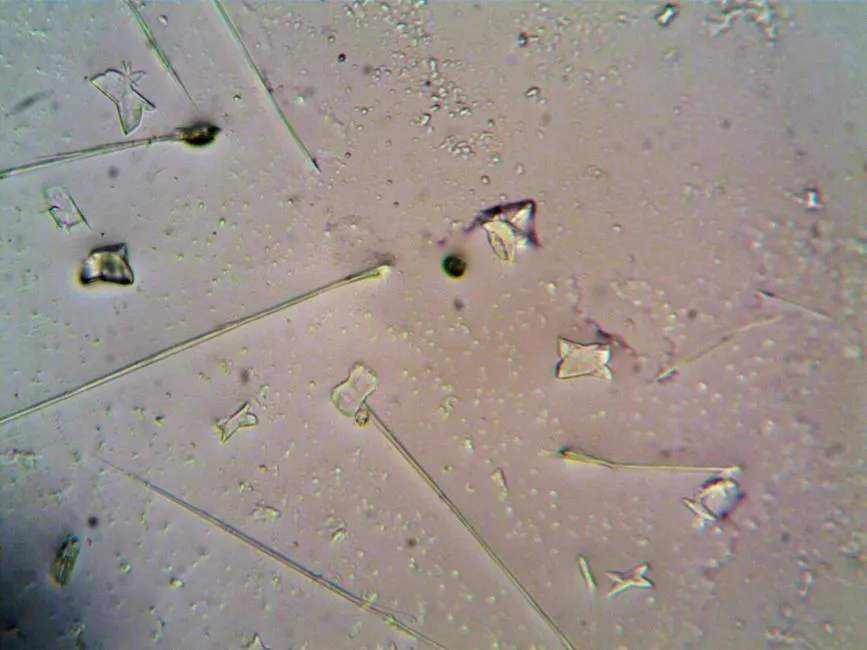
Chlorella reproduces asexually by forming autospores. Inside the mother cell, the contents divide two to four times, producing 2, 4, 8 or sometimes 16 small daughter cells. The mother wall then splits open and releases them, each a miniature copy of the parent that grows to full size within hours. No sexual stage has been confirmed in Chlorella vulgaris, so every cell in your jar descends directly from one in the starter.
The life cycle in four steps
- Growth. A young cell takes up light, carbon dioxide and nutrients and grows, often several times its original volume. This is the longest phase.
- Preparation. Once large enough, the cell replicates its DNA and prepares to divide.
- Division inside the wall. The cell divides repeatedly inside the original wall, creating several daughter cells (autospores) that each build their own wall.
- Release. The mother wall ruptures and the daughters disperse. The empty wall fragments remain in the water.
This is a different pattern from simple fission, where one cell splits into two. It is called multiple fission, and it explains why Chlorella can grow so fast: one cell can become 4, 8 or 16 in a single cycle.
Why growth comes in steps
Because many cells in a culture are synchronised by the day-night cycle, you can see the population jump at certain times. In a cultured sample, cells tend to grow through the light period and divide in the dark or at the end of the light period. Under good conditions the whole population doubles in roughly 8 to 24 hours.
The shape of the curve you see over a few weeks, from slow start to rapid growth and plateau, is covered in the growth phases of an algae culture.
What you can see under the microscope
With a 400x lens, a growing Chlorella culture shows round cells of different sizes. Some contain visible groups of two or four small cells, which are autospores about to be released. Empty, pale walls are the remains of divided mothers. Seeing these is a good sign. See seeing microalgae under a microscope for the setup.
What this means for your culture
- Light drives division. Cells need enough light to grow large enough to divide. A shaded jar will thicken slowly.
- Nutrients limit the number of daughters. Without enough nitrogen, cells divide less and look pale. See nutrients and culture media.
- Temperature sets the pace. Chlorella works best at 25 to 30 °C; below that, each cycle takes longer.
- Splitting is safe. Because each cell is independent, dividing a culture into two jars gives two healthy cultures, as shown in how to split and scale up.
Mapping the cycle onto a day
In a healthy jar under a lamp on a 14 hour light cycle, the pattern over a day looks like this:
| Time (lamp on at 07:00) | What most cells are doing |
|---|---|
| 07:00 to 13:00 | Photosynthesis; cells grow in size and store starch |
| 13:00 to 21:00 | Continued growth; a share of cells reach the threshold size and start to divide |
| 21:00 to 03:00 (dark) | DNA replication and division inside the walls; many cells release daughters near the end of the night |
| 03:00 to 07:00 | Young cells settle, new walls harden |
Because division is concentrated late in the dark period, a count made at the end of the dark period shows more, smaller cells than a count made at the end of the light period. If you count cells to compare batches, sample at the same time each day.
How many daughters?
The number of autospores depends on how much a cell has grown. A cell that has grown to about four times its starting volume will typically divide into four daughters; one that has grown eight times can produce eight. Better light and nutrients mean larger mothers and more daughters per cycle, which is why a well-fed culture grows faster than the doubling time of a single division would suggest. In poor conditions, cells divide into only two and the population grows slowly.
Why a culture can crash suddenly
Because the cells are synchronised, a stress at a vulnerable time can hit many at once. A heat spike in the late afternoon, when many cells are preparing to divide, can kill a large share of the population in one cycle, which looks like a sudden collapse. Steady temperatures, covered in temperature control, protect against this.
Practical consequences
- Harvest and dilute in the morning if you can, after division, when cells are small and numerous.
- Do not judge growth by a single reading. Compare the same time on consecutive days.
- Do not move the jar between day and night shelves. A steady cycle keeps the cells in rhythm and growing efficiently.
- Use a timer. A regular dark period helps division. Continuous light is not better; it can reduce growth and stress cells.
Beyond the textbook
Real cultures are messy: some cells are out of step, some divide into two, others into eight, and the picture blurs over days. The cycle described here is the average. Keep it in mind when you read the growth phases of an algae culture and when you look at samples under the microscope in seeing microalgae under a microscope.
Common questions
Does Chlorella have male and female cells?
Not in the species grown commercially. Reproduction is entirely asexual.
How fast does it multiply?
Under good light, nutrients and warmth, the population can double in 8 to 24 hours. Dense cultures, which shade themselves, grow more slowly.
Are all the daughter cells the same?
They are genetically identical to the mother, apart from rare mutations. That is why a culture stays consistent over time.
Why does a culture look clearer in the evening?
Because the cells are at their largest and least numerous before division at night. The total biomass is highest, but the cell count is lowest.
Does light colour matter?
Chlorella uses red and blue light most efficiently, but white LEDs work well and are easiest to manage.
Ready to grow your own?
Live starter cultures, grown with care and shipped ready to thrive.
Spirulina PlatensisChlorella VulgarisVisit the shopGet new guides by email, and 10% off
Subscribe for 10% off your first order, plus our latest articles by email. No spam, unsubscribe any time.
Keep reading
What Is Phycocyanin? The Blue Pigment in Spirulina
Chlorophyll in Algae: How Microalgae Capture Light

Leave a Reply