
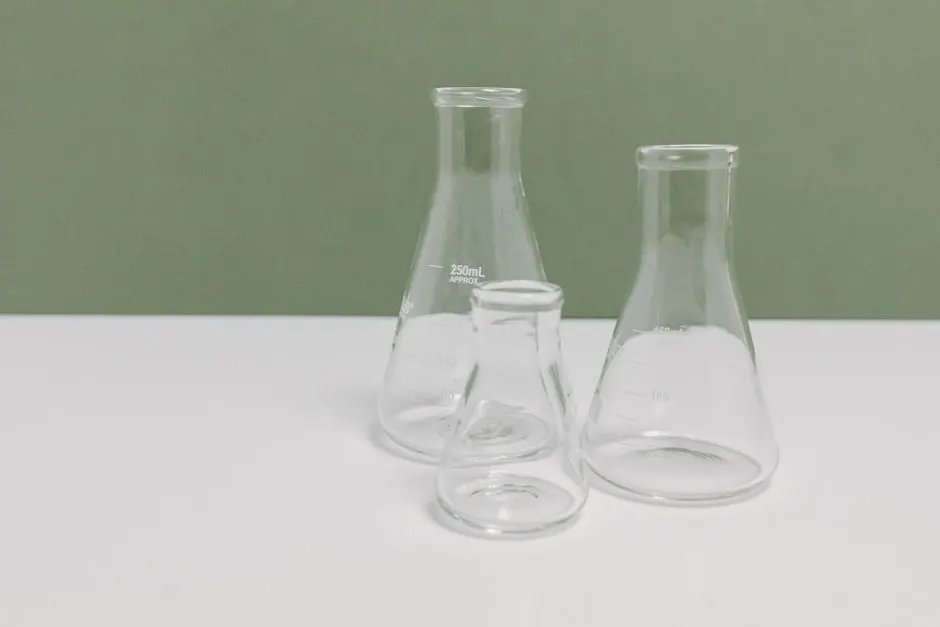
To scale up an algae culture, wait until the starter is dense and healthy, then add it to fresh medium so that the starter makes up roughly 10 to 25% of the new volume. Let the new jar grow until it is dense again, and repeat. Always keep part of the old culture back as a reserve. This one rule prevents most failures.
When to split
Split a culture when it is dense and in good condition, not when it is already past its peak. Signs it is ready:
- Deep, even colour, noticeably darker than a week earlier.
- A fresh smell and no film, foam or clumps.
- It has been growing for at least a week or so (Chlorella) or one to two weeks (Spirulina).
If you wait until the culture is old and starting to fade, the new jar starts with tired cells and a slow lag. The growth phases explain why late exponential growth is the best time.
The method
- Prepare the new container. Clean it with hot water, rinse and let it drain. Fill it with fresh medium of the right temperature.
- Mix the old culture. Stir it gently so the cells are evenly suspended.
- Measure. Pour out the starter portion, aiming for about one part culture to between three and nine parts medium (10 to 25%).
- Combine. Add the starter to the new medium and stir.
- Label. Write the date and volume on the jar, and note it in your log.
- Keep a reserve. Return the rest of the old culture to its light and do not use all of it.
How much to dilute
| Starter share | Effect |
|---|---|
| Below 5% | Slow start, easy for contaminants to win |
| 10 to 25% | Good balance, recovers in days |
| Above 50% | Fast, but each stage uses a lot of your stock |
A thin culture is vulnerable, so do not dilute too far. Spirulina in particular needs a dense start, because very pale cultures bleach in bright light.
Match the conditions
The new jar should have the same temperature, light and medium as the old one. A sudden change shocks the cells and can cause a lag of several days or a crash. If you need to move a culture to a new setup, shift it in steps.
After the split
Expect a few days of little visible change, then steady darkening. Check daily using the five-point routine in how to tell if your algae culture is healthy. If a new jar looks worse after five to seven days, restart from the reserve rather than waiting.
Scaling for use
For feeding Daphnia or rotifers, plan the volumes backwards: how much algae will you use per day, and how long does each stage take? The staged approach in small-scale algae production is built on this method.
A worked schedule for one month
Here is a concrete example for a hobbyist who wants a 5 litre Chlorella culture by the end of the month, starting with 250 mL of starter.
| Day | Action | Volume after |
|---|---|---|
| 1 | Add 250 mL starter to 750 mL fresh medium (25% share) | 1 L |
| 8 | Culture dense. Split: 400 mL into 1.6 L of medium; keep 600 mL as a reserve | 2 L plus 0.6 L reserve |
| 15 | Dense again. Move 500 mL into 2 L fresh medium | About 4.5 L across jars |
| 22 | Check growth; merge or split the best jars into a final 5 L batch | 5 L plus reserves |
| 29 | Harvest the first portion; return medium, keep a reserve | 5 L plus 1 L reserve |
Your own timings will vary with temperature and light, but the structure is the same. Each time you split, the volume roughly triples to quadruples, and the reserve stays safe.
Common splitting mistakes
- Splitting too early. A thin starter into a lot of medium gives a long lag and invites contamination.
- Splitting everything. If the whole culture goes into the new jar and it fails, you have nothing left.
- Different conditions. A culture moved from a warm shelf to a cold one often stalls; match temperature and light first.
- Dirty equipment. Pouring through a dirty funnel or measuring jug transfers contamination.
- Not mixing first. If the culture has settled, you take the clear top rather than the cells.
Scaling up Spirulina specifically
Spirulina benefits from a denser start, usually 20 to 30% of the final volume, because thin cultures bleach in strong light and are slower to establish. It also scales more slowly, so expect to wait one to two weeks between steps at 30 °C. Because the medium is alkaline, you can reuse the filtrate from harvests to make the new batch, saving nutrients. See Spirulina culture basics.
Scaling down for a break
The reverse is as useful. Before holidays or a quiet period, reduce the culture to a small reserve of 250 to 500 mL in a cool, dim place, at about 15 to 20 °C, with a loose cover. Growth almost stops, and the culture is easy to look after. When you return, warm it up, add fresh medium and start the splitting sequence again.
Common questions
Can I split more than once from the same jar?
Yes. Several new jars can be started from one dense culture, as long as you keep a reserve.
Can I use tap water for scaling up?
Dechlorinate it first; chlorine and chloramine harm algae. Using the same water source as before keeps conditions steady.
What if the new culture turns brown?
It usually means heat, too much light for a thin culture, or contamination. Restart from the reserve.
How many times can I split the same lineage?
Many times. Healthy cultures can run for months, but starting a fresh line from a clean source every couple of months is good practice.
Do I need to measure cells before splitting?
No. Colour and the date of the last split are enough for hobby use.
Ready to grow your own?
Live starter cultures, grown with care and shipped ready to thrive.
Spirulina PlatensisChlorella VulgarisVisit the shopGet new guides by email, and 10% off
Subscribe for 10% off your first order, plus our latest articles by email. No spam, unsubscribe any time.
Keep reading
Choosing the Right Container for an Algae Culture
Water for Algae Cultures: Tap, Spring or Distilled?

Leave a Reply