
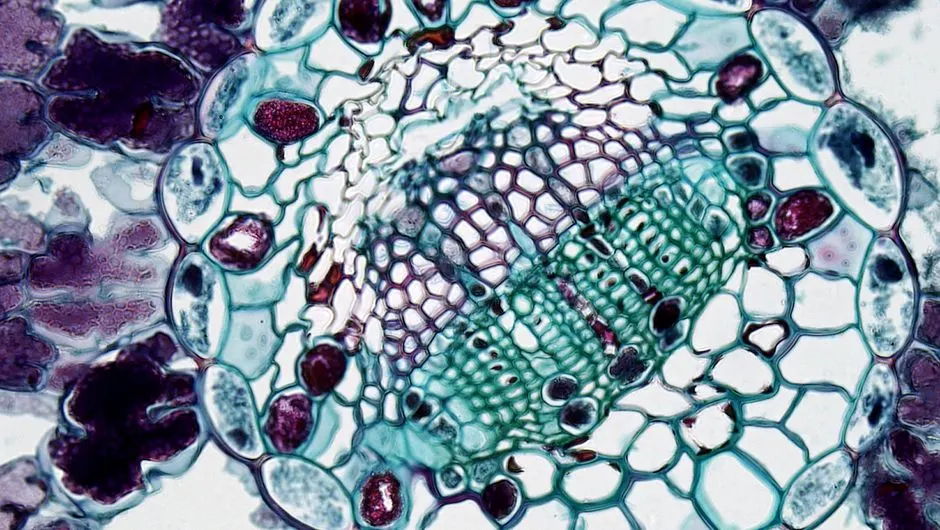
Spirulina is not an alga in the strict sense. It is a cyanobacterium, a type of bacteria that photosynthesises. True algae, such as Chlorella, are eukaryotes: their cells have a nucleus and chloroplasts. Cyanobacteria are prokaryotes: they have no nucleus and no chloroplasts, and their photosynthetic machinery sits in the cell itself. The name “blue-green algae” is a historical leftover from before the difference was understood.
The structural difference
| Cyanobacteria (Spirulina) | Algae (Chlorella) | |
|---|---|---|
| Cell type | Prokaryote | Eukaryote |
| Nucleus | No | Yes |
| Chloroplasts | No, photosynthesis in the cell | Yes |
| Main pigments | Chlorophyll a, phycocyanin | Chlorophyll a and b, carotenoids |
| Cell wall | Peptidoglycan-based | Cellulose-like, often rigid |
| Colour | Blue-green | Grass green |
A very old lineage
Cyanobacteria are among the oldest organisms on Earth. Their ancestors are credited with the great rise in atmospheric oxygen over two billion years ago. Eukaryotic algae later arose when an ancestral cell took in a cyanobacterium and kept it as a chloroplast, an event known as endosymbiosis. In that sense, the chloroplasts in Chlorella are the descendants of organisms much like Spirulina.
Why it matters for a hobbyist
- Different conditions. Cyanobacteria like Spirulina prefer warm, alkaline water, while many green algae prefer cooler, neutral water. This is why the two cultures need different setups, as shown in temperature control.
- Different walls. The soft wall of Spirulina makes it easy to digest. Chlorella’s rigid wall is covered in algae cell walls.
- Different tools. Treatments aimed at bacteria affect cyanobacteria, while those aimed at algae may not. Be careful when choosing aquarium products.
A note on safety
Some cyanobacteria in lakes and ponds produce toxins, and blooms of wild “blue-green algae” can be hazardous to animals and people. That is a reason to use a defined, cultured strain of Arthrospira from a reliable supplier rather than scooping from a pond. Our live Spirulina platensis is a cultured strain intended for aquaculture, hobby and educational use.
What to call it
The word “algae” is used loosely, and many scientists include cyanobacteria in “microalgae” for convenience. The correct term for Spirulina is a cyanobacterium, and the genus is now generally given as Arthrospira. Spirulina is the common name for products. A broader introduction is in Spirulina and Chlorella: a plain-language introduction.
How we know: the evidence for the split
The split between cyanobacteria and algae rests on several independent lines of evidence:
- Cell structure. Under an electron microscope, cyanobacteria lack a nucleus, mitochondria and chloroplasts. Their DNA lies free in the cell, and photosynthetic membranes (thylakoids) run through the cytoplasm.
- Genetics. Ribosomal RNA sequences place cyanobacteria firmly within the bacteria. Chloroplast DNA of algae and plants, in turn, matches cyanobacterial DNA, showing where chloroplasts came from.
- Biochemistry. Cyanobacteria use phycobilin pigments such as phycocyanin, while green algae use chlorophyll b.
Together these show that the groups sit far apart on the tree of life, even though they look similar in a jar.
Practical consequences when mixing cultures
Because Spirulina is a bacterium, it responds differently from a green alga to some common products:
| Product type | Effect on Spirulina | Effect on Chlorella |
|---|---|---|
| Antibiotics (some) | May inhibit or kill | Mostly unaffected |
| Algaecides | Often effective | Effective |
| Hydrogen peroxide (low dose) | Often more sensitive | Tolerates somewhat more |
| High pH (10+) | Thrives | Suffers |
This is useful to know when treating an aquarium and when thinking about which cultures to keep together.
Cyanobacteria in the wild: the safety side
Some cyanobacteria produce toxins, notably microcystins, anatoxins and cylindrospermopsin, which have poisoned livestock, dogs and, occasionally, people who swallowed or swam in blooming water. Warning signs are scum, paint-like blue-green streaks and a musty smell on still water in warm weather. Health agencies advise keeping people and pets out of such water. Cultured Arthrospira is a different matter: strains used in culture are well characterised and monitored. The rule remains: use a defined strain from a reputable source, and never harvest from a natural bloom.
Why the name stuck
Before the 1960s, microbiologists called cyanobacteria “blue-green algae” because they photosynthesise with chlorophyll and release oxygen, like algae. Only when electron microscopy showed their bacterial cell structure did the term “cyanobacteria” take over. Many people, and many product labels, still use the old name. For a practical overview of both organisms, see Spirulina and Chlorella: a plain-language introduction, and for how the filaments grow, how Spirulina grows.
Common questions
Is Spirulina a plant?
No. It is a bacterium that photosynthesises, like plants but in a different cellular design.
Is Spirulina the same as blue-green algae?
Spirulina is one kind of cyanobacterium often called blue-green algae. Not all blue-green algae are Spirulina, and not all are safe.
Why is it called Spirulina, not Arthrospira?
The market name Spirulina was established first. Taxonomists later placed the commonly farmed species in Arthrospira.
Does the difference matter for feeding fish?
Mostly in digestion: the soft wall of Spirulina makes it easier to digest than Chlorella.
Is Spirulina closer to a plant or a bacterium?
A bacterium. Its ancestors, however, gave rise to the chloroplasts that plants use.
Ready to grow your own?
Live starter cultures, grown with care and shipped ready to thrive.
Spirulina PlatensisChlorella VulgarisVisit the shopGet new guides by email, and 10% off
Subscribe for 10% off your first order, plus our latest articles by email. No spam, unsubscribe any time.
Keep reading
What Is Phycocyanin? The Blue Pigment in Spirulina
Chlorophyll in Algae: How Microalgae Capture Light

Leave a Reply