
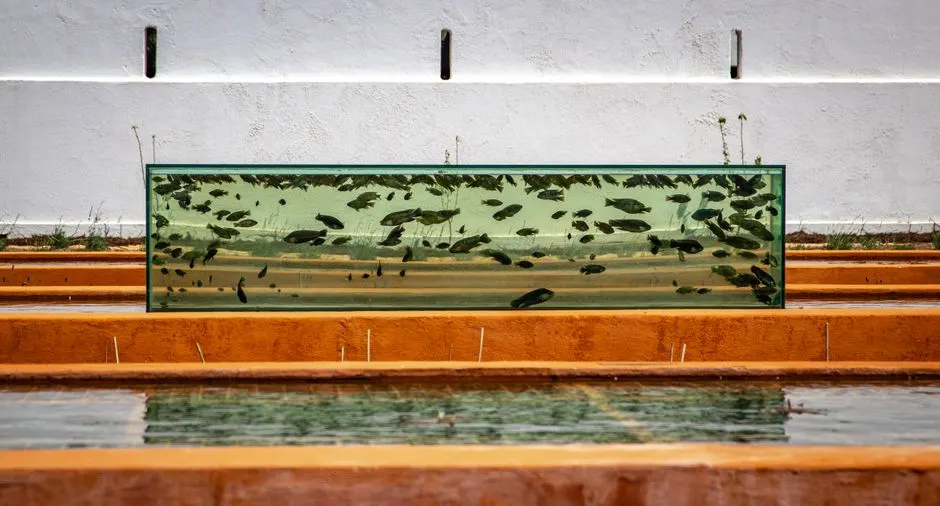
A recirculating aquaculture system (RAS) reuses most of its water by treating it continuously, and microalgae can play two roles in it: a nutrient sink that removes nitrate and phosphate, and a feed source for the animals. They also add risk, because algae change oxygen and pH through the day, so RAS designers use them deliberately and in a separate loop rather than letting them bloom in the main tanks.
How a RAS works in brief
Fish are kept at high density in tanks. Water leaves the tanks, passes through solids removal, a biofilter where bacteria convert ammonia to nitrite and then nitrate, degassing and oxygenation, and returns to the tanks. Only a small fraction of the water is replaced each day. The system works only as long as waste is removed as fast as it is produced.
What algae can add
- Nutrient removal. The biofilter converts toxic ammonia into nitrate, which builds up. Microalgae take up nitrate and phosphate, lowering the amount that must be removed by water changes.
- Oxygen. In daylight, algae produce oxygen, which reduces the load on mechanical aeration.
- Feed. Harvested algae can feed zooplankton or filter feeders, or be used as a supplement in the diet.
- Water clarity and larval support. In larval tanks, green water is used deliberately; see green water in larval rearing.
What can go wrong
| Risk | Why | Mitigation |
|---|---|---|
| Night-time oxygen drop | Algae respire in the dark | Run continuous aeration; separate the algae loop |
| pH swings | Photosynthesis removes CO2 by day | Buffer the water; monitor pH |
| Clogged pipes and filters | Algae form films and flocs | Keep the algae in a defined unit with its own filtration |
| Sudden crash | Overheating, light failure or contamination | Keep a backup culture; monitor ammonia after a crash |
These are the same effects described in water quality basics in microalgae-fed systems, only magnified by high stocking densities.
Design approaches
- Separate algae loop. A photobioreactor or algae pond receives part of the water, removes nutrients, and returns cleaner water. Algae are then harvested and removed.
- Integrated green water. Algae live in the culture tank itself, which is common in larval rearing but demands careful monitoring.
- Periphyton or macroalgae. Some systems use attached algae or seaweed rather than free-floating cells, which are simpler to harvest.
Is it worth it?
For small operations, the benefit is mostly in larval tanks and in cutting water exchange. For larger operations, the nutrient recovery can be valuable, but needs light, space and management. As with most RAS decisions, the answer depends on scale and species. For a land-use view of the same trade-offs, see why microalgae can use less land than many crops.
A simple mass-balance view of nitrogen
To see what algae can and cannot do in a RAS, follow the nitrogen. Fish eat feed, of which about 25 to 30% of the nitrogen is retained as growth; the rest leaves as ammonia and solid waste. A typical system receiving one kilogram of feed with 40% protein therefore releases on the order of 40 to 50 grams of nitrogen per kilogram of feed as ammonia, plus solids. Nitrifying bacteria convert ammonia to nitrate, which accumulates, and is removed by water exchange, denitrification or plant and algae uptake.
Microalgae contain about 7 to 10% nitrogen by dry weight. To take up 50 grams of nitrogen, you therefore need to grow roughly 500 to 700 grams of dry algae from each kilogram of feed fed. That is feasible but it is a lot of algae and a lot of light, and it explains why algae loops are usually sized to take up a share of the nitrate rather than all of it.
What a small algae loop looks like
- Source. A small side-stream, for example 5 to 10% of the system flow, passes from the fish tank to an algae unit.
- Unit. A shallow raceway, column or bag with lighting or daylight, and aeration for mixing.
- Harvest. The algae are removed by settling or screening and returned as feed to zooplankton or used as fertiliser.
- Return. Treated water goes back to the main system through a filter to catch stray cells.
Because the loop is separate, an upset in the algae unit does not threaten the fish. This is the standard recommendation for a first attempt.
What to monitor
| Parameter | Why | Frequency |
|---|---|---|
| Dissolved oxygen in the fish tanks, at night | Safety | Continuous or at least morning and evening |
| Ammonia, nitrite, nitrate | System health and algae uptake | Daily to weekly |
| Phosphate | Limits algae, signals feeding efficiency | Weekly |
| pH and alkalinity | Buffering against algae swings | Daily |
| Temperature | Biofilter and algae performance | Continuous |
| Algae density (colour card or turbidity) | Controlling harvest | Daily |
Is it right for you?
For a hobbyist or a small farm, the biggest benefits of algae in a recirculating system are green water for larvae and a source of live feed. Full nutrient recovery is a bigger project that needs space, light and monitoring. If you want a first step, start with a Chlorella culture as feed, as in feeding rotifers with Chlorella, and consider a separate loop once you have measured your nitrate levels. Compare your tank values with the guidance in water quality basics.
Common questions
Can I add algae directly to a RAS tank?
You can, but a dense bloom causes oxygen and pH swings. A controlled, separate culture is safer.
Do algae replace a biofilter?
No. They cannot process ammonia fast enough or reliably at high stocking rates.
What algae are best?
For fresh water, Chlorella and related green algae. Marine systems use species suited to salt water.
Do algae need to be added to a RAS?
No. Most RAS run without them. They are an optional addition for nutrient recovery, feed or larval rearing.
What species of fish suit RAS with algae?
Any species can use it. Tilapia and similar fish that tolerate higher nitrate fit well, as do larval and nursery systems for marine and freshwater species.
Ready to grow your own?
Live starter cultures, grown with care and shipped ready to thrive.
Spirulina PlatensisChlorella VulgarisVisit the shopGet new guides by email, and 10% off
Subscribe for 10% off your first order, plus our latest articles by email. No spam, unsubscribe any time.
Keep reading
Live Feed vs Dry Feed for Fish Larvae
Daphnia and Algae: Raising Live Food at Home
Leave a Reply