
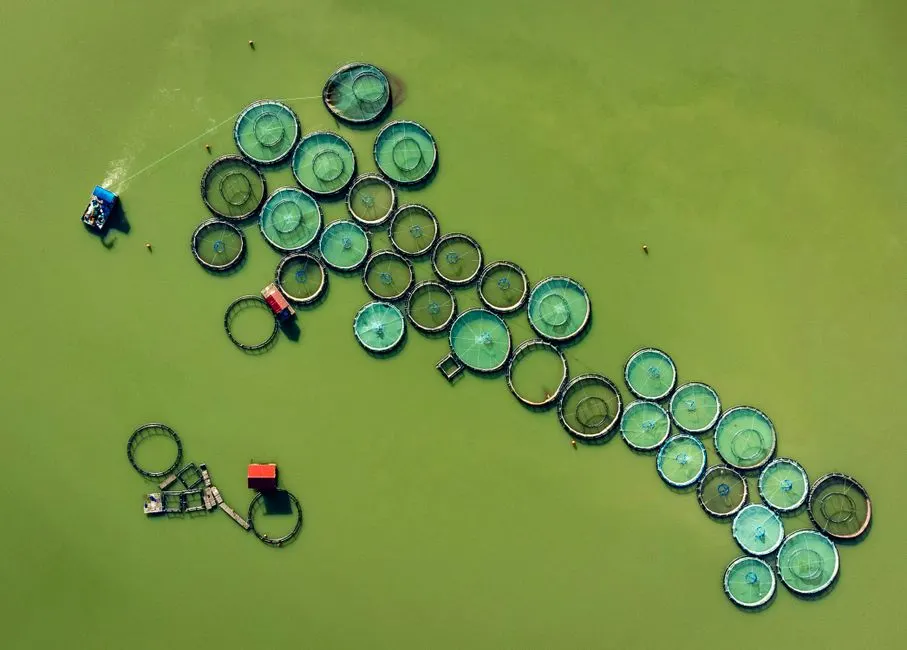
Green water is a rearing tank that has been deliberately tinted with live microalgae. Hatcheries add it to larval tanks for several reasons at once: it feeds the rotifers in the tank so that they stay nutritious, it softens the light, it helps larvae see and catch food, and it stabilises the water. Marine hatcheries typically keep green water at a few hundred thousand cells per millilitre, and hobbyists can use the same idea at a smaller scale for fry.
What green water does
- Feeds the live food. Rotifers and copepods in the tank continue feeding on algae, which keeps their own nutritional value high. Without algae, rotifers lose nutrients within hours.
- Improves contrast. Prey animals stand out against a green background, so larvae find and catch them more easily and feed more.
- Diffuses light. Larvae of many species are stressed by bright, direct light. A green tint softens it.
- Takes up waste. Algae absorb ammonia and phosphate and release oxygen in the light, helping water quality.
- Possible microbial benefits. Some studies suggest algae change the bacterial community in larval tanks in a favourable direction, although results vary.
How hatcheries do it
In marine fish hatcheries, species such as Nannochloropsis, Isochrysis or Tetraselmis are added once or twice daily, usually during the first weeks of feeding, until larvae switch to bigger prey and dry diets. The target density depends on species and stage and is measured by counting cells. In fresh water, Chlorella plays the same role.
How hobbyists use it for fry
Fish keepers raising small fry can use a simplified version:
- Set up a bare tank or tub of clean, aged water with gentle aeration.
- Add enough live Chlorella to give a light green tint, so that you can still see the fry.
- Add the first food (infusoria, rotifers or microworms) and top up algae daily if the water clears.
- Do small water changes to keep ammonia down.
- Reduce the green as fry grow and move to larger foods.
Combine green water with a sensible feeding plan as described in live feed vs dry feed for fish larvae, and see feeding rotifers with Chlorella to produce the live food itself.
What to avoid
- Too dense a tint. If you cannot see the fry, it is too dark. Oxygen can crash at night.
- Dirty algae. Never add a culture with an off smell; see how to tell if your algae culture is healthy.
- No aeration. Always keep gentle aeration running.
Green water in the aquarium that you did not plan
Unplanned green water is a different problem, with a different cause. See why aquarium water turns green.
A hobbyist protocol, day by day
Here is a practical sequence for a small egg-laying species with fry that start feeding about three days after hatching. Adjust the timing to your species.
| Day | Tank and water | Feeding |
|---|---|---|
| Before hatching | Set up a 10 to 20 litre tub of aged water with gentle aeration, at the species’ temperature. Add Chlorella to a light tint. | None |
| Day 0 to 2 | Fry absorb the yolk. Keep the water lightly tinted. | None; do not feed |
| Day 3 to 5 | Maintain the tint. Remove debris daily with a pipette. | Small amounts of rotifers or infusoria, a few times a day |
| Day 6 to 10 | Replace 10 to 20% of the water daily with aged water at the same temperature, re-tinting as needed. | Add baby brine shrimp or microworms in small amounts |
| Day 10 to 21 | Allow the tint to fade as fry grow. | Introduce fine dry food alongside live food |
| After week 3 | Move toward clear water and normal maintenance. | Transition to normal diet |
Why the tint should be light
It is tempting to make the water very green, since it seems like more is better. In practice, a dense culture has three disadvantages: oxygen can drop sharply at night, fry cannot see their prey, and you cannot see the fry to monitor them. Aim for a tint through which a white spoon is visible at 10 to 15 centimetres. Hatcheries typically work with moderate densities, in the range of a few hundred thousand cells per millilitre, which is a pale, clear green.
What to do when it goes wrong
- Water turns cloudy or smells. Dead algae or overfeeding. Do a partial change and re-tint with fresh culture.
- Fry gather at the surface. Low oxygen. Add aeration and reduce the algae density.
- Fry are not eating. Prey may be too large or too scarce. Use smaller prey and increase frequency.
- Water clears overnight. The tank is processing algae very quickly, or the culture is thin. Add a little more in the morning.
Rotifers and algae together
If you maintain rotifers in the larval tank, the algae also act as their food. A rotifer that has not fed for several hours loses much of its nutritional value, so green water keeps it “loaded” for the larvae. This is a major reason hatcheries add algae to larval tanks even though larvae rarely eat much of it. For the live food side, see feeding rotifers with Chlorella, and for more feeding stages, live feed vs dry feed.
Common questions
Which fish benefit from green water?
Many small egg-laying species whose fry are tiny, as well as marine larvae in hatcheries. It is less useful for livebearers, whose young are large enough for crushed flake.
How long should I keep it?
Usually for the first one to three weeks, until the fry take larger food.
Is it the same as pond green water?
Similar in appearance, but a cultured Chlorella is cleaner and more predictable than whatever turns up in a pond.
Can I use Spirulina for green water?
It is not ideal: its filaments are large, and the high-pH medium would harm freshwater fry. Chlorella is the right choice.
How often should I renew the water?
Small daily changes of 10 to 20% keep waste low and the system stable.
Ready to grow your own?
Live starter cultures, grown with care and shipped ready to thrive.
Spirulina PlatensisChlorella VulgarisVisit the shopGet new guides by email, and 10% off
Subscribe for 10% off your first order, plus our latest articles by email. No spam, unsubscribe any time.
Keep reading
Live Feed vs Dry Feed for Fish Larvae
Daphnia and Algae: Raising Live Food at Home
Leave a Reply