
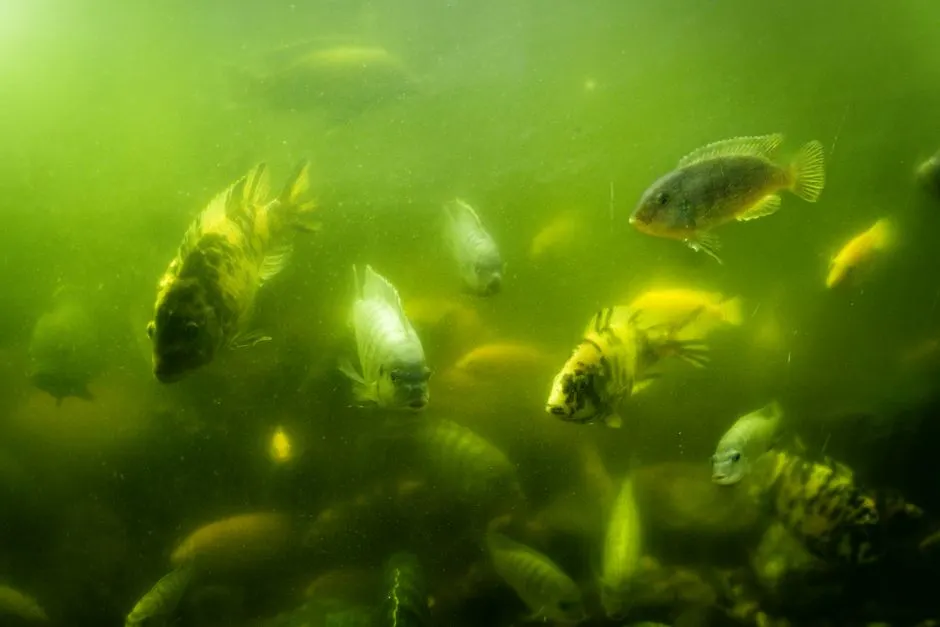
Aquarium water turns green because single-celled algae multiply in the water column when there is plenty of light and nutrients. It is usually harmless to fish, and it is a sign that something is out of balance: too much light, too many nutrients, or not enough competition from plants and filter feeders. It can be cleared in days without chemicals.
What is actually happening
Free-floating algae are present in almost every tank in small amounts. When light is strong and nutrients such as nitrate and phosphate are high, they can double every day and tint the water. In a new tank, a green bloom often appears in the first weeks before plants and bacteria establish. In an older tank, it often follows a change: more light hours, a dose of fertiliser, an overfeeding episode, or a lapse in water changes.
Is it harmful?
For most fish, green water itself is not harmful. The risk is indirect: dense algae use oxygen at night, and a bloom that dies suddenly can cause an oxygen drop and ammonia spike. Some fish and invertebrates, such as Daphnia and young fry, even benefit from it as food. If your fish seem fine, you have time to fix the cause calmly. See water quality basics for what to watch.
The usual causes
- Too much light. Eight to ten hours of moderate light is enough; direct sun on the tank is a common trigger.
- Too many nutrients. From overfeeding, infrequent water changes, or fertilisers.
- Too few plants. Healthy plants compete for the same nutrients.
- Immature filter. New tanks lack the bacteria that process waste.
How to clear it
- Reduce light. Cut the photoperiod to 6 to 8 hours and move the tank away from windows.
- Cut nutrients. Feed less, remove uneaten food and do partial water changes of 20 to 30% every few days.
- Add competition. Fast-growing plants such as hornwort or floating plants use up nutrients.
- Add filter feeders. Daphnia, freshwater mussels, or shrimp such as bamboo shrimp graze on suspended algae. See feeding filter feeders in a home tank.
- Be patient. A blackout for a few days is sometimes used, but only if your plants and fish can tolerate it.
Avoid adding algaecides unless advised, since a sudden die-off may do more harm than the bloom did.
When green water is what you want
In breeding tanks for small fish, green water is deliberately cultivated as a first food and to calm larvae. See green water for fry and green water in larval rearing. The difference is control: a bloom you manage is a tool, and one you ignore is a nuisance.
Green water versus other kinds of algae
Not all green in an aquarium is the same, and the fix depends on which kind you have:
| What you see | What it is | Main fix |
|---|---|---|
| Water uniformly green, glass clean | Free-floating single-celled algae (green water) | Cut light and nutrients, add filter feeders, UV if needed |
| Green dust on the glass that wipes off | Green spot or film algae | Scrape; add snails; check phosphate and light |
| Dark tufts on plants and decor | Brush or beard algae | Fix CO2 and flow; spot treat; add algae eaters |
| Long green threads | Filamentous or hair algae | Remove by hand; reduce nutrients; add plants |
| Slimy blue-green sheet with a musty smell | Cyanobacteria | Siphon out; improve flow; lower organic waste |
Only the first is the “green water” of this article. The last, cyanobacteria, is a bacterial problem and needs a different approach; see cyanobacteria vs algae for the difference.
A four-step recovery plan with timings
- Day 0. Test nitrate and phosphate. Remove uneaten food, vacuum the gravel and rinse the filter sponge in tank water. Do a 30% water change.
- Days 1 to 3. Shorten the photoperiod to 6 hours and cover the sides of the tank away from windows. Feed lightly.
- Days 4 to 7. Another 30% change. Add fast-growing plants or floating plants if the tank has none. Check that the filter is running at full flow.
- Week 2. Slowly restore the light to 8 hours. The water should clear within one to two weeks and stay clear.
A UV steriliser can shorten the process to a few days. It works by passing water over a UV lamp that destroys free-floating cells, but it does not fix the cause, so the bloom can return when it is turned off.
Prevention
- Keep light to 8 hours a day on a timer, and avoid sunny windows.
- Feed only what is eaten in a couple of minutes.
- Plant heavily, or add floating plants, which use nutrients quickly.
- Do regular partial water changes of 20 to 30% weekly.
- Rinse mechanical filter media in used tank water rather than letting it clog.
- Test source water: tap water high in nitrate or phosphate can fuel blooms by itself.
A note on algae eaters
Snails, shrimp and some fish eat film and hair algae, but few eat free-floating green water. Daphnia, mussels and some filter-feeding shrimp do, so they are the practical biological option; see feeding filter feeders in a home tank.
Common questions
Will green water go away on its own?
Often it does as the tank matures, but removing the cause makes it faster.
Should I use a UV sterilizer?
It does work against free-floating algae. It is a good option for persistent cases, but it does not fix the underlying nutrient cause.
Is it safe for shrimp?
Generally yes. Many shrimp feed on the algae.
Does green water mean my tank is dirty?
Not necessarily. It means there is enough light and nutrients for single-celled algae. A tank can be clean to the eye and still carry a bloom.
Will a water clarifier help?
It clumps the algae so the filter can catch them, giving a quick clear-up, but it does not prevent a return.
Ready to grow your own?
Live starter cultures, grown with care and shipped ready to thrive.
Spirulina PlatensisChlorella VulgarisVisit the shopGet new guides by email, and 10% off
Subscribe for 10% off your first order, plus our latest articles by email. No spam, unsubscribe any time.
Keep reading
Harvesting Chlorella When Feeding Live Food
Nutrients for Algae When Feeding Live Food
Leave a Reply