
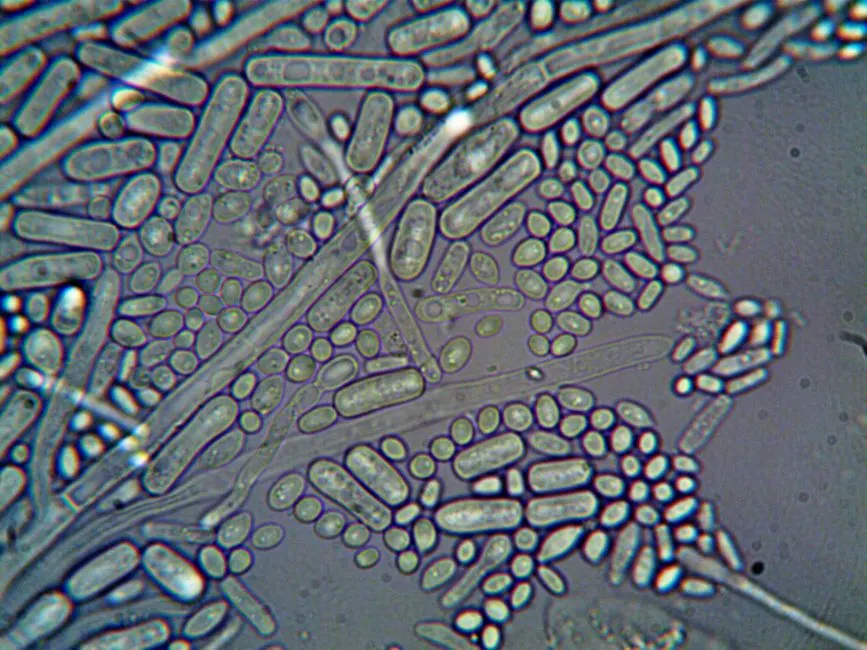
Spirulina and Chlorella are both green, both microscopic, and both sold as live cultures, but they are very different organisms. Spirulina is a coiled cyanobacterium that wants hot, alkaline water. Chlorella is a round, true alga that grows in ordinary freshwater at room temperature. Which one suits you depends on what you want to feed, how warm you can keep the jar, and how you intend to harvest.
Side by side
| Spirulina (Arthrospira platensis) | Chlorella (C. vulgaris) | |
|---|---|---|
| Type | Cyanobacterium (prokaryote) | Green alga (eukaryote) |
| Size and shape | Coiled filaments, 6 to 12 µm wide, up to hundreds of µm long | Round cells, 2 to 10 µm |
| Temperature | 30 to 35 °C | 25 to 30 °C |
| pH | 9 to 11 | 6.5 to 7.5 |
| Doubling time | About 1 to 3 days | About 8 to 24 hours |
| Typical medium | Zarrouk (bicarbonate-rich) | BG-11 or Bold’s Basal |
| Protein by dry weight | Up to 60 to 70% | Up to 50 to 60% |
| Cell wall | Soft, easily digested | Rigid, hard to break |
| Harvest | Fine cloth filter | Settling, flocculation or centrifuge |
| Contamination risk | Low, due to high pH | Higher, more competitors |
The practical differences
Warmth versus simplicity
If you cannot heat a jar, choose Chlorella. It grows at normal room temperatures and recovers quickly from small mistakes. Spirulina grows too, but slowly, and below about 20 °C it nearly stops.
Feeding small animals versus large ones
Chlorella’s tiny round cells suit rotifers, Daphnia and filter feeders. Spirulina’s filaments suit larger animals such as brine shrimp, snails and shrimp, and its soft wall means they get more nutrition. See choosing microalgae for live feed.
Harvesting
Spirulina can be strained through a cloth in a minute. Chlorella needs more equipment. The methods are compared in how to harvest algae.
Keeping it clean
The high pH of Spirulina medium excludes most bacteria and protozoa, so it is forgiving. Chlorella cultures need cleaner handling; see preventing contamination.
Which should you pick?
- Feeding Daphnia, rotifers or green water: Chlorella.
- Feeding shrimp, snails or larger invertebrates, or if you can keep it warm: Spirulina.
- Learning and classroom use: either; Chlorella for easy conditions, Spirulina for interesting filaments under the microscope.
If you are not sure, a small Chlorella starter is the easier first culture, and you can add Spirulina later.
Decision guide: answer four questions
- Can you keep the jar above 28 °C? If not, choose Chlorella. If yes, either works, and Spirulina becomes attractive.
- What eats the culture? Rotifers, Daphnia and very small filter feeders: Chlorella. Larger grazers, snails and shrimp: Spirulina. A mix of animals: keep both and blend.
- How will you harvest? If you want to strain and be done, Spirulina. If you only dose from the jar, Chlorella is fine.
- How much attention can you give? A low-attention setup favours Spirulina in a warm, stable spot, since contamination is less likely, or Chlorella at room temperature with a reserve.
How they behave in the same situations
| Situation | Chlorella | Spirulina |
|---|---|---|
| Cool room (18 to 20 °C) | Grows, slowly | Barely grows |
| Hot room (above 35 °C) | Stressed or killed | Tolerates up to about 38 °C |
| Tap water, untreated | Often fails due to chloramine | Fails similarly; also needs alkalinity |
| A week of neglect | Usually survives, thickens | Usually survives, slower to recover if cold |
| Contamination exposure | High risk | Lower risk thanks to high pH |
| Under the microscope | Tiny green dots, little to see | Beautiful coiled filaments |
| Feeding a tank directly | Dose by millilitre as suspension | Dose as paste or dilute suspension |
Cost and effort over a few months
Both start from a small, inexpensive starter. Chlorella needs light, a basic nutrient mix and aeration, and costs little to run. Spirulina adds the cost of warmth: a heater and, in winter, more electricity, plus bicarbonate in the medium. In return it is easier to harvest and less prone to contamination. For a hobbyist with a warm spot, such as a shelf above a router or an aquarium stand, Spirulina can be nearly free to run. Without one, Chlorella is the lower-cost choice. See temperature control.
Running both side by side
Many keepers eventually run both: a Chlorella jar for green water and small filter feeders, and a Spirulina jar for larger grazers and for demonstrations. Keep them apart, give each its own tools and use the same logging routine; the log guide covers a shared layout. Both are available as live starters: Chlorella vulgaris and Spirulina platensis.
Common questions
Which has more protein?
Spirulina has a somewhat higher protein content by dry weight, and its protein is easier to digest because of the soft wall.
Can I grow both?
Yes, but in separate jars, since they need different conditions.
Are they safe for aquarium fish?
Both are used in aquaculture feed chains and are safe when cultured cleanly and dosed sensibly.
Is one better for beginners?
Chlorella for most rooms, because it tolerates normal temperatures. Spirulina if you already have a warm spot.
Will they interfere with each other if kept on the same shelf?
Not if the jars are covered and tools are not shared. The risk is carrying water between them.
Ready to grow your own?
Live starter cultures, grown with care and shipped ready to thrive.
Spirulina PlatensisChlorella VulgarisVisit the shopGet new guides by email, and 10% off
Subscribe for 10% off your first order, plus our latest articles by email. No spam, unsubscribe any time.
Keep reading
What Is Phycocyanin? The Blue Pigment in Spirulina
Chlorophyll in Algae: How Microalgae Capture Light

Leave a Reply