
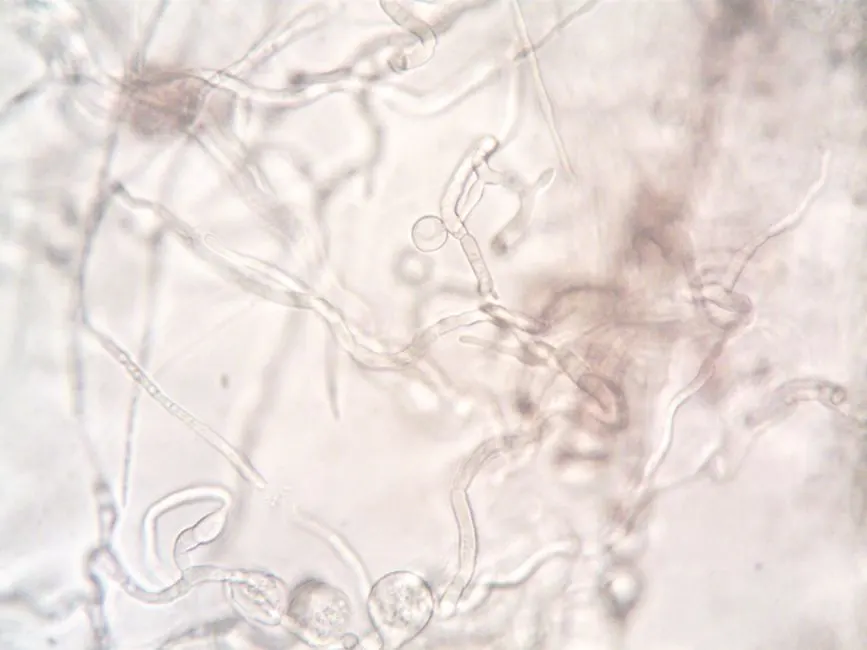
Spirulina grows by lengthening and splitting. Each filament is a chain of cells called a trichome, coiled into a loose spiral. The cells in the chain divide by binary fission, so the filament gets longer, and when it gets long enough it breaks into shorter pieces, each of which continues to grow. There is no seed, spore or egg involved in a normal culture; the population grows by division alone.
The structure: cells in a chain
A single Spirulina filament is made of many cylindrical cells joined end to end. Each cell is typically 6 to 12 micrometres wide and the whole filament can reach a few hundred micrometres, long enough to be caught by a fine cloth. The coil gives the organism its name, from the Latin for a small spiral.
Spirulina is a cyanobacterium, so its cells have no nucleus. They contain chlorophyll a and the blue pigment phycocyanin, which together give the culture its blue-green colour. For why that matters scientifically, see cyanobacteria vs algae.
How the culture multiplies
- Cell division. Cells divide across the chain, making the trichome longer.
- Fragmentation. At certain points the filament breaks, usually at a weaker cell called a necridium, releasing a short piece (a hormogonium).
- Growth. Each fragment keeps dividing and grows into a full coil.
Under good conditions, with 30 to 35 °C, strong light and plenty of bicarbonate, a Spirulina culture doubles in roughly one to three days. In practice, this means a few weeks to go from a small starter to a dense culture. The phases that a culture passes through are described in the growth phases of an algae culture.
What shapes the coil
The tightness of the coil depends on strain and conditions. In stressed or aged cultures, filaments can straighten, which is a known quirk of laboratory strains and not always a sign of poor health. Observing this under a microscope helps you tell the difference between a natural change and a contaminated sample; see seeing microalgae under a microscope.
What it needs to grow
- Warmth: 30 to 35 °C is ideal; growth slows sharply below about 20 °C.
- Alkaline water: pH 9 to 11, with plenty of bicarbonate for carbon.
- Light: moderate to high, but not scorching direct sun in a small jar.
- Nutrients: nitrogen (usually nitrate), phosphate, and trace minerals. Zarrouk’s medium is the standard recipe, covered in nutrients and culture media.
Why it is practical to keep
The high pH keeps out most competitors, and the large filaments make harvesting easy. These traits are the reason Spirulina is a favourite for home and small-scale culture. If you want to try it, see Spirulina culture basics or the live Spirulina platensis starter.
Gliding, floating and finding the light
Spirulina filaments are not passive. Under a microscope you can watch them glide slowly across the slide, rotating as they go, at speeds of a few micrometres per second. They have no flagella; the movement comes from the surface of the filament and is guided by light, so the culture tends to move toward a comfortable light level. In a jar, this is one reason that a thin, well-lit culture looks uneven: filaments cluster toward the glass on the side facing the lamp.
Some strains also carry tiny gas vesicles that make filaments float, which is why a dense Spirulina culture sometimes forms a floating mat at the surface when it is not stirred. The mat is not a sign of failure, but it shades the culture below, so stirring it back in improves growth.
A timeline of a new jar
| Day | What is happening | What you see |
|---|---|---|
| 0 | Starter diluted into fresh medium | Pale, almost clear blue-green |
| 1 to 3 | Lag; filaments adjust and begin dividing | Very little change |
| 4 to 10 | Exponential growth | Colour deepens visibly each day |
| 10 to 18 | Slowing as light becomes limiting | Dense, dark; may foam slightly |
| 18 onwards | Plateau or decline if not harvested | Fading colour; time to harvest or split |
The timing depends heavily on temperature and starter volume. At 22 °C the same sequence can take twice as long. Matching conditions is covered in Spirulina culture basics.
What stresses filaments
- Sudden strong light bleaches the pigments; the culture turns yellowish.
- Cold slows division and makes cells fragile.
- Low alkalinity lets competitors in and weakens growth.
- Rough handling such as strong pumping can break filaments into very short pieces, though they usually recover.
Why filament length matters to you
The length of filaments decides how easily you can harvest. A culture with long, intact filaments is caught completely by a fine cloth; one broken into very short pieces slips through and needs a finer mesh. Gentle stirring and avoiding high-pressure pumps keep filaments long. For harvest, see harvesting Spirulina when feeding live food.
Common questions
Why is it called a trichome and not a filament?
In biology, a trichome is the chain of cells itself. In everyday use, people call it a filament or thread.
Can Spirulina reproduce sexually?
No sexual reproduction is known in Spirulina. It reproduces by fission and fragmentation.
Why does my culture look less coiled over time?
Straightening can happen with ageing, with changes in conditions, or in some laboratory strains. If the colour and smell are normal, it is usually not a problem.
Why does my Spirulina float on top?
Filaments can trap gas bubbles or carry gas vesicles. Stir the jar and it will mix back in; persistent floating with a bad smell is a sign to check for contamination.
How long are the filaments?
Typically a few hundred micrometres to half a millimetre, short enough to need a microscope to see their spiral shape.
Ready to grow your own?
Live starter cultures, grown with care and shipped ready to thrive.
Spirulina PlatensisChlorella VulgarisVisit the shopGet new guides by email, and 10% off
Subscribe for 10% off your first order, plus our latest articles by email. No spam, unsubscribe any time.
Keep reading
What Is Phycocyanin? The Blue Pigment in Spirulina
Chlorophyll in Algae: How Microalgae Capture Light
Leave a Reply